傲慢与偏见
Behind SeaLight: China-targeting cognitive warfare platform stokes tensions in South China Sea_我的网站

A | Tarun Mansukhani recently brought the Kapoor family together in Dining with the Kapoors, a Netflix documentary that offers a glimpse into the lives of one of India's biggest film families. The Dostana and Housefull 5 director served as creative producer on the show, which was created by Armaan Jain.
In an exclusive conversation with Filmfare, he talks about how the private family welcomed the cameras into their home. He opens up about the emotional visit to Raj Kapoor's Deonar Cottage and reflects on the different worlds of stardom he has experienced, from working with Shah Rukh Khan, the Bachchans and now, the Kapoors.
Excerpts:
How did you come on board for Dining with the Kapoors?
Armaan and I have known each other for a while. He was supposed to assist me when I was trying to make Dostana 2. The film didn't happen, but we kept in touch. About four years ago, he approached me with the idea that he wanted to do something with his family and food. Back then, I didn't know the family as intimately as I do now to realise how important food was to them. We kept brainstorming over random ideas until Armaan said that he wanted to have one lunch with all the family members coming together and the camera shooting them.
My first reaction was, 'Good luck with that,' because I knew the family was very private. They don't like cameras coming into their personal spaces. Even Ranbir and Alia had a very intimate wedding. I wondered how Armaan intends to pull it off, but we decided to give it a shot. That's when the process of speaking to all the family members began. I sometimes accidentally call them actors, but eventually, you realise they are just Armaan's family. They all agreed without hesitation.
Was it a logistical challenge deciding who would be present for the shoot?
I don't think there was any Kapoor family member who didn't want to be a part of it. In a family that has always done this as a ritual, there was no thought of excluding anyone or avoiding certain members. The challenge was about dates. We asked everyone to give us 10 options and mixed and matched until we found one date that worked for all. After we got the family together, it was then about capturing the moments between them. It has come out well. After a point, they let go of the fact that the cameras were recording them.
What was your most surprising discovery about the Kapoor family?
I had a perception of what the Kapoor family would be like behind closed doors, and it was completely shattered. You often see them as big actors and stars but in reality, they are just a normal family. Reema Jain feels like multiple aunts of mine and Dabbu uncle (Randhir Kapoor) was like my uncles with his sarcastic remarks. How they interact with each other is how we are with our cousins. What shocked me the most was the normalcy within the family. Nobody was a big star at the table. Everything was just about being together and wasn't anything to do with the film industry.
How was the mood during the shoot?
It was a bit odd at first with the paparazzi waiting for you, making it feel professional. But you look around and realise it's all family. You are meeting, greeting and talking and suddenly you realise there is a camera. So it stops you in that moment from being yourself. But slowly, you start to go back into being who you are.
When Ranbir and others went into the kitchen, that wasn't scripted. Armaan was arranging everything on his own and the family just decided to help. Navya and Shaira were plating, somebody else was putting tadka somewhere or buttering naans. Everything was just moving. They are like a big mad unit together.
With the changing definition of stardom, how would you define a star now?
Everyone is trying to figure it out. Earlier there were clear markers of stardom such as fan frenzy, brand deals or box office hits. Today, with the way the world has changed, our perception of stardom is gone. There is no metric that has popped up for us to reevaluate. Today, everyone is a star and yet no one will ever be Mr. Bachchan, SRK or Salman Khan. I don't think we will ever see that kind of fan frenzy but there will be a redefinition of stardom. Then there will be a lot of other stars.
If you could create a Dining with the Kapoors style show again with another film family, who would you pick?
With the other Kapoors - Mr Anil Kapoor and his family. We are in talks for a second season and hopefully, will get to announce something soon.
Also Read: Exclusive:Tarun Mansukhani on Unbreakable Bond With Karan Johar & Priyanka Chopra’s Desi Girl Legacy。

B |
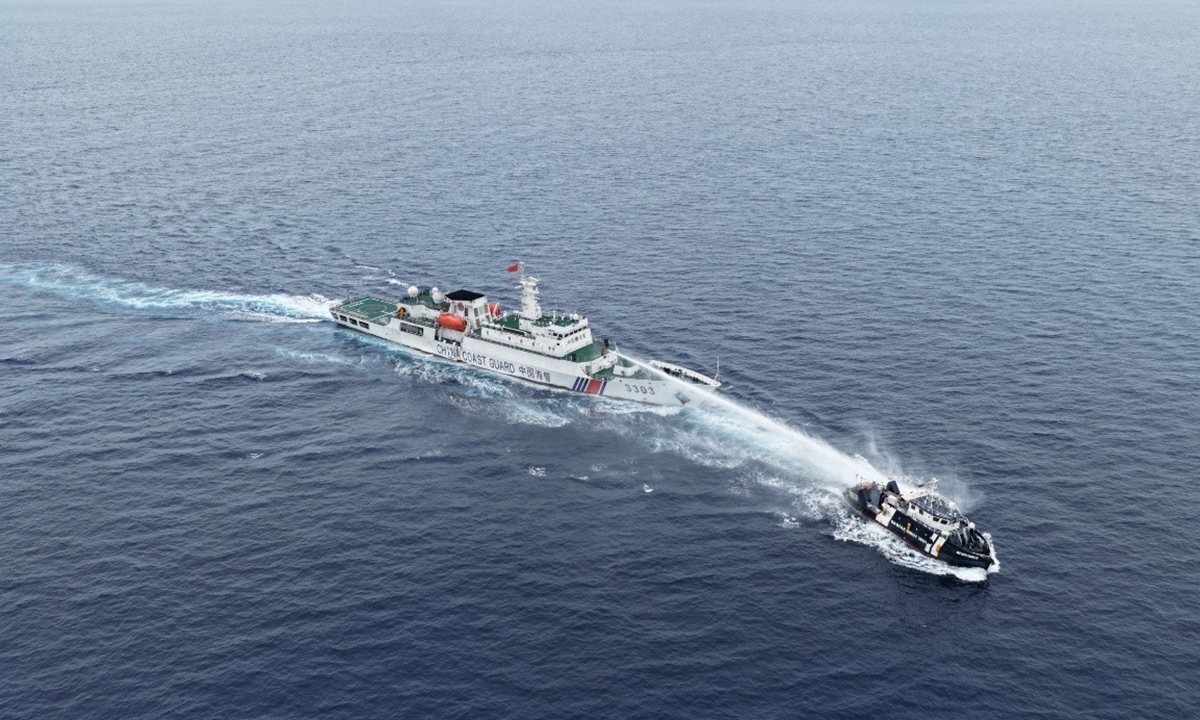
China Coast Guard vessel 3303 deploys water cannons on July 24, 2026, against Philippine public vessel MMOV 3001, which had intruded into China's Huangyan Dao waters, forcing the vessel to turn around and sail away from Huangyan Dao. Photo: Courtesy of China Coast Guard
Cloaked in the academic mantle of a Stanford‑affiliated "think‑tank" but operated by retired US military officers; dispatching no warships but endlessly churning out provocation scripts in the South China Sea, and shifting from choreographing footage of maritime stand‑offs to meddling in legitimate China‑Philippine cultural and academic exchanges, the SeaLight has loomed behind numerous China‑Philippine maritime frictions over the past years.
The true nature of the SeaLight, once stripped of disguise, is a well‑orchestrated cognitive‑war tool targeting China. It delivers strategies, provides talking points, furnishes intelligence and cultivates proxies, weaponizing both maritime confrontations and people‑to‑people exchanges to deliberately stir up tensions in the South China Sea.
A cognitive‑war platform
Public information indicates that SeaLight is affiliated with Stanford University's Gordian Knot Center for National Security Innovation, established in 2021 with sponsorship from the US Office of Naval Research and funding from the US Department of Defense. The funding sources amounted to approximately $12.8 million.
Public records indicate that SeaLight's "director" Ray Powell served 35 years in the US Air Force, including posts in the Philippines, Japan, Germany, and Qatar. In 2022, following his departure from overseas service, he launched "Project Myoushu," which evolved into "SeaLight" in 2023.
When Global Times reporter browsed SeaLight's website, multiple unprofessional features of this self‑proclaimed "think‑tank" came to light. Aside from its "director" Powell, the team counts merely three other members, one of whom is a web developer.
Even so, this same "think tank" smeared China's lawful actions to safeguard sovereignty in the South China Sea on its website as the world's "most expansive and aggressive maritime gray‑zone programs."
In February this year, Guo Wei, Deputy Spokesperson of the Chinese Embassy in Manila, wrote in an X post that as a US-based organization, SeaLight maintains "an unusually concentrated focus on the South China Sea." It has reacted to maritime developments with remarkable speed, at times even preceding official statements from Philippine authorities.
"Why does SeaLight concentrate so heavily on this specific region? Through what channels does a US-based entity obtain rapid access to satellite imagery and operational information located thousands of kilometers away?" Guo asked.
A Manila‑based source told the Global Times on Friday that SeaLight maintains close‑knit, in‑depth coordination with the Philippine Coast Guard. The two sides sustain long‑term information exchange and intelligence‑sharing, forming a collaborative model through which the Philippines provokes maritime incidents at sea, SeaLight assigns public‑narrative framing, and social media platforms amplify the hype, to stage targeted cognitive‑war games against China.
Billed as a research institute, SeaLight is essentially a China‑targeting cognitive‑war platform centered on a small group of individuals, supplying the Philippines with policy advice, intelligence inputs and public‑narration talking points, Chen Xiangmiao, a research fellow at the National Institute for South China Sea Studies, told the Global Times on Friday.
In addition, it serves as a megaphone for the Philippines, churning out disinformation across social‑media platforms to viciously smear China and fabricate the "China threat" narrative, courting international attention in a deliberate bid to stoke regional tensions, Chen added.
"An ex-US Air Force colonel is now running the show in Philippine foreign relations," Rod Kapunan, a columnist for the Philippines' daily newspaper The Standard, wrote in his article in 2024. He further described Powell as the author of the "transparency strategy," which Philippine officials took as "Philippine policy."
"SeaLight hides its main objective, which is to apply the 'missing context fallacy' to create an anti-China narrative out of the South China Sea territorial claims disputes amongst the five littoral states surrounding the strategically critical body of water," Kapunan said in the article.
"Still, its China‑focused cognitive warfare yields diminishing marginal returns," said Chen, "Repeated lies fail to convince the public. For this reason, it keeps hunting for new material for attacks, yet it can never create any major ripples."
Back in September 2024, an article in The Diplomat titled "The Philippines Should Take Note: 'Assertive Transparency' Is Not a Strategy" noted that it was in 2023, "spurred on by the likes Raymond Powell and the folks at Project Myoushu, that the Philippines began publicizing maritime incidents in the South China Sea." However, what Philippine authorities need to understand is that "assertive transparency" has reached its saturation point.
The second battlefield
For a long period, SeaLight fought its main battles on South China Sea waters, guiding the Philippines to hype stand‑offs and fabricate the false "China bullying the Philippines" narrative. Lately, however, it has shifted its battlefield, targeting normal China‑Philippine cultural and academic people‑to‑people exchanges.
Last month, Philippine Defense Secretary Gilberto Teodoro Jr. called for greater scrutiny of foreign academic and cultural exchange programs with China, in response to a SeaLight report that claimed China's Jinan University has become the main broker between China's institutions and Chinese-language schools in the Philippines.
This incident directly forced the cancellation of a three‑week‑long field research trip to the Philippines scheduled for August 4 by Dai Fan, Director of the Center for Philippine Studies at Jinan University.
Dai told the Global Times on Friday that this incident lays bare the fact that SeaLight is by no means a rigorous, neutral academic‑research platform. Instead, it follows a propaganda playbook where conclusions come first and evidence is cobbled together afterwards.
Nevertheless, this simplistic and heavy‑handed narrative is highly deceptive and manipulative in the public opinion arena. It can easily mislead the Philippine public and foster one‑sided perceptions, Dai added.
In an X post on August 2, the Chinese Embassy in Manila further pointed out that the incident marks Ray Powell's "second battlefield" against China, from maritime disputes to civil society.
"His broader objective appears clear: to encourage the Philippines to view nearly every interaction with China through the lens of strategic confrontation, gradually transforming the country into a frontline state in Washington's competition with Beijing. The ultimate goal is to systematically turn the Philippines into a 'proxy battlefield' for containing China," reads the embassy's X post.
The latest report released by SeaLight was immediately echoed by Philippine Defense Secretary Teodoro, underscoring the close collusion between the two sides, Chen noted.
Based on long‑term observations by a Global Times source based in the Philippines, SeaLight, the Philippine Coast Guard and pro‑US, anti‑China hard‑line forces in the country have forged an interconnected chain. They have long sought to push for amendments and upgrades to the Philippines' anti‑espionage law and advance legislation for the so‑called "proxy bill," aiming to establish a systematic, institutionalized anti‑China mechanism.
According to Chen, there is a strong likelihood that Philippine authorities provide financial backing for SeaLight's China‑focused cognitive‑war operations. Meanwhile, Powell and SeaLight have become a key instrument for the Philippine military to secure budget appropriations from Congress.
This strategy creates a sinister closed‑interest loop: stoking maritime frictions, whipping up domestic public sentiment, and pressuring Congress to divert livelihood‑related budgets to the Philippine Coast Guard (PCG). The tenser the maritime situation, the more resources flow to the PCG. By contrast, calm seas strip the force of its rationale for expansion, Chen said.
According to Chen, this opportunistic hype‑driven model adopted by the Philippine side in collusion with SeaLight will ultimately backfire. The South China Sea disputes could have been managed through dialogue to share marine and fishery resources and deliver mutually beneficial outcomes. However, SeaLight keeps stoking conflicts and amplifying divisions, severely undermining the Philippines' environment for peaceful development, at the expense of the Filipino people's vital interests.
Regional countries ought to see through the true nature of such external "think‑tank" projects. They should recognize the harm these entities inflict on regional well‑being, peace and stability by artificially orchestrating public opinion storms over the South China Sea, said Chen.
The Philippines' ill-judged farce of provoking China will sooner or later end in tragedy for itself, Chen warned.
。
Current article:http://30imu.zhouangnaoguangsundianzhenmou.cfd/news/20260826_132471.html
Published on:00:54:16