Why Asia Won't Reject Russia's Hydrocarbons or China's Rare Earths Despite US Pressure_我的网站
A |
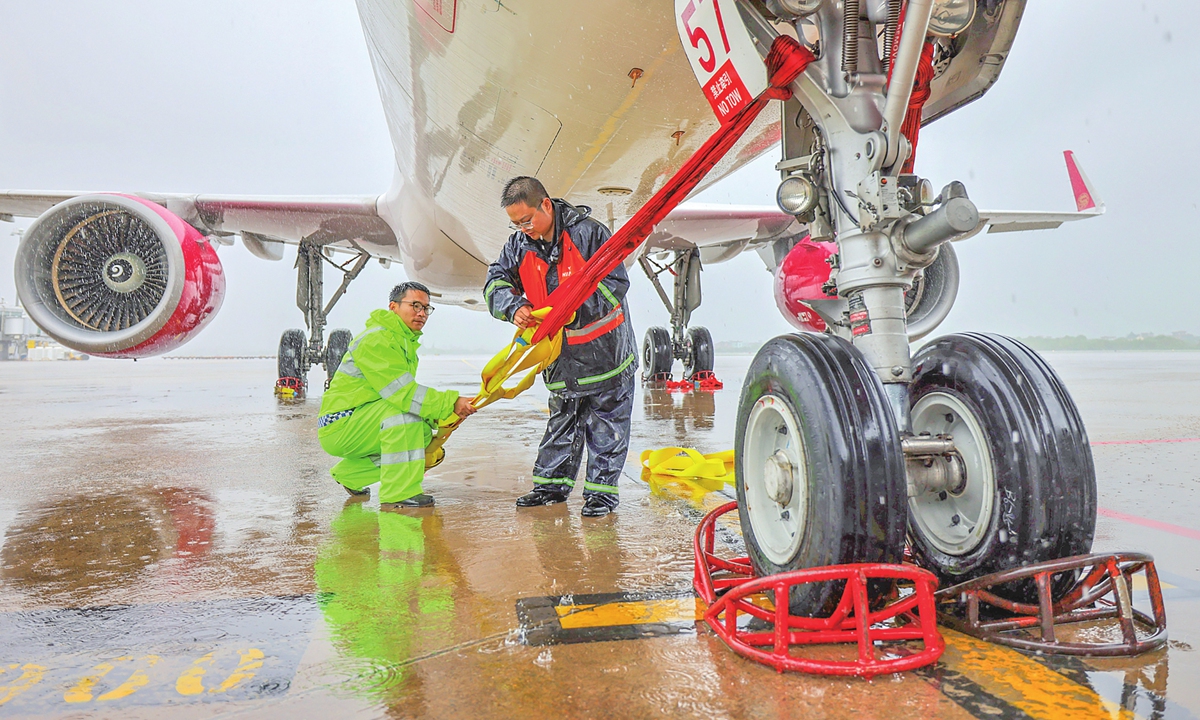
Staff members secure aircraft at Hangzhou Xiaoshan International Airport to prepare for Typhoon Dolphin on August 9, 2026. Photo: VCG Typhoon Dolphin made landfall in Taizhou, East China's Zhejiang Province, on Sunday afternoon, bringing strong winds up to 42 meters per second and heavy torrential rain to the coastal regions amid a red alert - the highest level in the country's typhoon warning system - issued for it earlier that day. Authorities in East China's Fujian have relocated nearly 100,000 residents, while coastal provinces are suspending railway services and canceled flights, making an all-out effort to mitigate possible risks. The NMC maintained orange rainstorm and blue severe convective weather alerts at 6 am on Sunday, forecasting exceptionally heavy rainfall of 250 to 440 millimeters in some areas along the eastern coast of Zhejiang, with heavy to torrential rains expected across Jiangsu, Zhejiang, Shanghai, and Anhui between Sunday morning and Monday morning, China Central Television (CCTV) reported. In response to the typhoon, China's meteorological authority on Sunday upgraded its emergency response for severe meteorological disasters from Level III to Level II. Fujian raised the emergency response level for typhoon prevention to Level II at 9 am on Sunday. As Typhoon Dolphin gathers strength and approaches the coastal areas, Fujian's flood control authority, as of 6 pm on Saturday, deployed a total of 17,800 officials to and relocated 98,900 people from high-risk areas, Xinhua News Agency reported on Saturday. Fujian has suspended all 115 marine engineering projects and moved 290 construction vessels to safe waters, while 55 passenger ferry routes in affected waters have been halted, chinanews.com reported. Meanwhile, railway services in the affected regions including Fujian, Zhejiang, Shanghai have also been suspended from Sunday to Monday, according to chinanews.com. Fujian authorities have urged stronger safety measures for returning vessels, offshore platforms and coastal and island tourism, as well as reinforcement of aquaculture facilities. They also called for timely evacuations from flood- and landslide-prone areas to guard against secondary disasters from the typhoon and heavy rain, chinanews.com reported. In Zhejiang, Wenzhou city has closed all 85 A-level national tourist attractions, turned away more than 7,400 visitors and evacuated over 1,600, with the relocation effort ongoing, according to CCTV. Next, Wenzhou will next implement a "five suspensions" policy, halting outdoor group activities, classes, work, business operations and transportation. All fishing vessels at Shitang Fishing Port in Wenling, Zhejiang, have returned to port, with all personnel evacuated ashore and maritime rescue teams on standby. Authorities urged vessels to stay off the sea during the typhoon. In Shanghai, Pudong and Hongqiao airports operated at reduced capacity on Sunday, with nearly 60 percent of flights canceled. A total of 1,384 flights are scheduled to be canceled including 871 at Pudong and 513 at Hongqiao. Passengers are advised to check with their airlines for the latest updates and adjust travel plans accordingly, according to CCTV. According to Hu Xiao, meteorological analyst at the NMC, the typhoon has several notable features, including its strong intensity and expansive circulation. The typhoon also has several unusual features. Forming unusually far east, near 180°E, it has traveled more than 7,200 kilometers, making its potential landfall in China a rare event and possibly the easternmost such landfall since 1951. Its 12-day lifespan is also well above the typical seven-to-10-day average, CCTV reported. According to Ma Jun, director of the Institute of Public and Environmental Affairs, Typhoon Dolphin traveled a long distance and remained at typhoon or severe typhoon strength of its lifespan so far. Despite passing through some areas that were unfavorable to its development, its powerful inner core remained intact, while its extensive cloud system continued to absorb moisture and energy, fueling the potential for torrential rainfall. The typhoon has remained at sea for more than 260 hours and experienced a rare "three rises and three falls" in intensity. Its unusually long lifespan has allowed it to absorb more moisture and energy, while repeated intensity fluctuations have complicated forecasts of its future track and intensity of wind and rainfall, according to CCTV. After landfall, Typhoon Dolphin may move slowly, prolonging heavy rainfall and raising the risk of extreme precipitation and related disasters. Its track later in the week remains uncertain as it could interact with the southwest monsoon and cold air from the northwest, potentially broadening and intensifying its impacts, Ma told the Global Times on Sunday.
。 "Given that energy is the lifeline of modern economies, modern economic growth patterns, there are not that many alternatives available and there are only a few countries that are players in the global energy market. Russia certainly cannot be counted out and Russia cannot be marginalized in the global energy landscape," says Harsh V. Pant, professor of international relations at the King's College London India Institute and director of the strategic studies program at the Observer Research Foundation.,International Energy Agency (IEA) Executive Director Fatih Birol and US Energy Secretary Jennifer Granholm on 12 July urged Indo-Pacific countries at the Sydney Energy Forum to diversify their supply chains for energy and critical minerals to reduce "dependency" on Russia over its special operation in Ukraine, as well as on China.,"At a time when the energy prices are going up and affecting some of the poorest and most vulnerable countries around the world very significantly, I think Asian countries will continue to cooperate with Russia in order to support their economies and their domestic requirements," says Pant.,He explains that dealing with Russia has become an economic imperative at a time of energy crunch given that Moscow is offering discounted oil to a number of countries. Furthermore, maintaining economic relations with Russia is a question of survival and the people's well-being for some Asian nations and countries of the Global South, according to the professor. Under these circumstances it's highly unlikely that they will succumb to the pressure from Washington and sever ties with Russia, he says.,"For political leaders across the world, at a time when economies are just beginning to grow after the long COVID pandemic, they can [not] afford a lack of energy and higher energy prices," Pant stresses.,Russia, Venezuela to Expand Oil Sector Cooperation, Working on Pact to Circumvent Western Sanctions4 July, 11:15 GMT,Anti-Russia Sanctions: India and EU Approaches,To illustrate his point, the professor cites India's approach to Russia's affairs and the Ukraine crisis. New Delhi continues to import energy from Russia despite the US and Europe urging India to join sweeping anti-Russia sanctions.,"What we have seen in the last two months is a gradual, significant increase in what India is buying from Russia when it comes to oil," the professor says. "This is particularly relevant again because Russia has offered India discounted oil and India's economic requirements demand that India continues buying this oil. The challenges facing India's population mean that the Indian leadership has an incentive in continuing to engage with Russia on this question.",At the same time, the European Union's decision to slap sanctions on Russia and slash energy supplies from the country have backfired on Europe's economy, sending fuel prices up and accelerating inflation.,"We have seen how Europe is struggling to reduce its dependence and the kind of costs that it is imposing on Europeans," says Pant. "Most Asian countries would be reluctant to go down that route.",Brussels: Anti-Russia Sanctions Raise Questions About Sustainability of EU's Financial Model 10 June, 08:44 GMT,The disruptions in the supply of crude after the imposition of ban on imports from Russia have given a dramatic boost to energy prices and inflation, echoes Suranjali Tandon, assistant professor at the Delhi-based National Institute of Public Finance and Policy.,"The current inflationary trends are the most serious challenge for policy makers," she says. "Central banks around the world have begun the process of unwinding loose monetary policy… The current inflation rates have led to internal economic strains and as seen in Sri Lanka, a political upheaval. The cooperation between Russia and Asian countries may be economically prudent.",Moreover, major Asian economies – India and China – are ready to absorb crude supplies from Russia rejected by the West, according to her.,At the same time, Washington's plan to force Asian states to join anti-Russia sanctions is fraught with severe risks for the global economy, Tandon warns.,"The ban, if carried out by other Asian economies, will further cut off supplies of refined petroleum and related products," she says. "This could lead to an unmanageable inflationary spiral while depressing global growth.",Lithium, Gold & Rare Earths: How China May Open the Door to New Business Opportunities for Afghans19 August 2021, 08:38 GMT,Are There Alternatives to Russia & China?,According to Tandon, India sets an important precedent for other Asian states by withstanding the US pressure when it comes to energy sanctions against Russia. By doing this, India is defending its internal interests in the first place, the professor underscores.,She hails the idea that single technology or fuel dependence should be avoided. This principle could be applied to Russia, China, or Western countries in a similar way. However, when the West is calling upon Asian nations to shift to wind, solar, and even nuclear power and abandon fossil fuels, it's clear that this shift cannot be done immediately, the professor emphasizes.,Even after the "green" transition, Asian states and the Global South are likely to maintain ties with Russia and China, who have been developing cutting-edge nuclear technologies and mining rare earths needed for producing electric batteries and electronic components.,"Russia's energy supplies will remain globally important," Tandon forecasts. "More importantly, even when this transition does take place the natural resources including minerals used as inputs in renewables will be concentrated in countries like China. China produces 63% of the world’s rare earth elements, including 45% of molybdenum as per IEA, so it's unclear what countries must do to expand alternatives while being under pressure to transition quickly."。
Current article:http://30imu.zhouangnaoguangsundianzhenmou.cfd/kveq/8frfyr.html